

Studying pharmacy in Spain is an important option for international students who want specialised health training with global recognition, especially because of the structured career path that requires an accredited degree and registration with the professional college (colegiación), plus an optional specialisation route through the FIR exam. Studying pharmacy in Spain differs from other countries in the language of instruction, admission requirements and job opportunities, especially in the medical field. In this complete guide, we explain everything about studying pharmacy in Spain, from admission requirements to the specialisation route through FIR, with a focus on universities, costs and the legal procedures you must follow.
🧮 Calculate your study cost in Spain in your own currency – official fees by region and university, housing and living costs (estimated) and scholarship eligibility in one minute: Study cost calculator
Admission requirements for studying pharmacy in Spain
Admission requirements for studying pharmacy in Spain vary according to the education system in the student’s country, but they usually require completing secondary school with a natural sciences track, plus an official validation procedure for a foreign secondary school certificate.
If you are a student from a non-EU country, your first step is to validate your secondary school certificate through the recognition process (homologación), handled by the Spanish Ministry of Education (Ministerio de Educación, FP y Deportes). This process is a basic requirement for applying to a bachelor’s degree in pharmacy. You apply through the Ministry of Education (form 790 code 079, about 49.76 €), then obtain the accreditation card from UNEDasiss. UNEDasiss does not admit students; admission is through pre-registration (preinscripción) at the university or region.
After completing the recognition process, you can optionally take specific tests known as the Pruebas de Competencias Específicas (PCE), organised by UNED (see the UNEDasiss website for current venues and dates). These tests can add up to 4 extra points to the assessment system, improving your chances of admission to Spanish universities, especially in regions such as Madrid, which is a major centre for pharmacy programmes.
The public universities in the Madrid region use a unified admission system (pre-registration, preinscripción), and your score is calculated from your certificate together with PCE results, if any. Not all of them offer the pharmacy degree, so check which universities offer it in RUCT.
Admission requirements vary by university, but they usually include:
- A recognised and certified secondary school certificate (with an Apostille or legalised by the embassy).
- An official translation of the certificate into Spanish by a sworn translator.
- Proof of Spanish proficiency (the level and the way of proving it vary from one university to another, often DELE or SIELE).
- Pre-registration (preinscripción) at the university or region.
Language of instruction in pharmacy programmes
Most bachelor’s programmes in pharmacy in Spain are taught in Spanish, which means that a good command of Spanish is essential for academic and professional success.
Many universities ask for proof of Spanish proficiency (such as DELE, SIELE or an in-house test), and the required level varies from one university to another; check the requirements of your target university.
Note that some universities may offer preparatory programmes or Spanish language courses before the start of studies, especially for students with limited knowledge of the language. These programmes help you adapt to the academic environment, but they are not a substitute for an official DELE certificate.
For postgraduate studies (master’s and doctorate), some programmes may be offered in English, but they are rare in pharmacy and are often aimed at students from specific European or international countries.
Universities that teach pharmacy in Spain
Public and private universities in Spain offer the Grado en Farmacia (bachelor’s degree in pharmacy), which lasts 5 years (300 ECTS).
Examples of universities that teach pharmacy (not a ranking; check RUCT and the official websites):
- Universidad Complutense de Madrid: a public university offering the pharmacy degree.
- Universidad de Granada: a public university offering the pharmacy degree.
- Universidad de Sevilla: a public university offering the pharmacy degree.
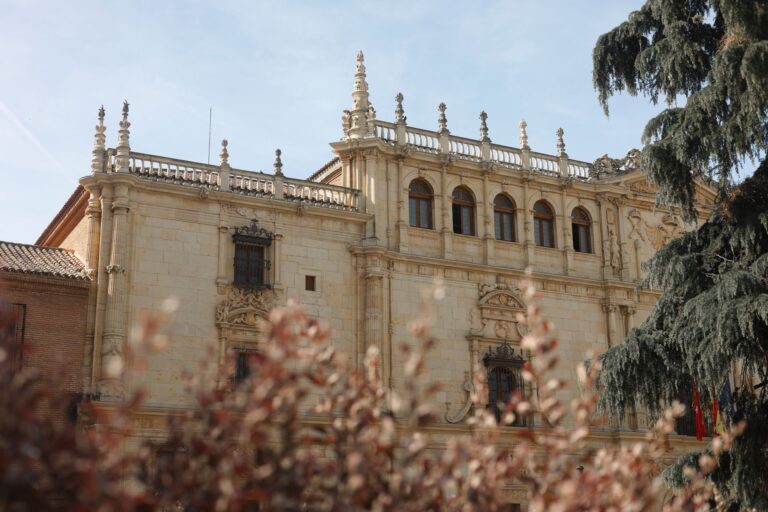
- Universidad de Alcalá: a public university near Madrid offering the pharmacy degree.
- Universitat de València: a public university offering the pharmacy degree.
- Universitat de Barcelona: a public university offering the pharmacy degree (the proportion of Catalan and Spanish as languages of instruction varies).
If you are looking for a complete experience, see the best universities in Spain guide and compare the available options by field, location and tuition fees.
Cost of studying in pharmacy programmes
The cost of studying pharmacy in Spain varies by type of university (public or private), city and stage of study.
At public universities, tuition fees are relatively low compared with other European countries, but an annual amount must be paid at registration. For planning, fees are set as follows:
- Fees at public universities are set by each autonomous community per credit (ECTS) and may be higher for non-resident students from outside the European Union: in Madrid 136.44 €/ECTS for level 1 (usually health sciences) at the fourth-enrolment price, which is about 8,186 € for 60 ECTS; Catalonia 17.69 €/credit for first enrolment, with the university possibly setting a higher price for non-residents; Valencia double the base price; Andalusia 12.62 €/credit as a base, with a possible surcharge by the university; Castilla y León no surcharge based on nationality (10.41–18.45 €/credit).
- Private universities set their own fees; check each university’s official website.
In addition to fees, students must cover living costs, estimated at 600 € per month (7,200 € per year) according to the IPREM 2026 value. This is the minimum required to prove funds, not an estimate of actual living costs.
International students must prove sufficient financial resources before applying for the visa, for example with a bank statement. The student’s own 100% of IPREM is not required if you prove that housing is paid in advance for the whole stay (Article 35 of RD 1155/2024).
| Type | Annual fees (EUR) | Additional costs (EUR/year) |
|---|---|---|
| Public universities | Depends on the region (see the list above) | The student’s own 100% of IPREM is not required if you prove that housing is paid in advance for the whole stay (Article 35 of RD 1155/2024) |
| Private universities | Set by each private university | The student’s own 100% of IPREM is not required if you prove that housing is paid in advance for the whole stay (Article 35 of RD 1155/2024) |
Getting a study visa for Spain
To study pharmacy in Spain, non-EU students must apply for a long-stay study permit (autorización de estancia de larga duración por estudios), issued by the Spanish embassy or consulate in your country.
Spain is a member of the Schengen area (29 countries), and a valid residence permit allows short trips within the area under the short-stay rules (up to 90 days in any 180 days); it does not give you the right to study or work in other countries.
The basic steps to get the visa:
- Obtain official admission from an accredited Spanish university.
- Submit the visa application at the Spanish consulate in your country (for example, the consulate in Tangier, Morocco).
- Pay the visa fee (it varies by consulate; check its website).
- Submit the required documents: a valid passport, admission letter, health insurance, bank statement, criminal record certificate (covering the last 5 years), medical certificate and certified documents.
- Wait for the visa decision (the time varies by consulate).
After arriving in Spain, you must register at the police office (Oficina de Extranjería) within one month of entry and obtain the residence card (TIE).
Working while studying in Spain
International students are allowed to work part-time while studying in Spain, without a separate work visa, provided the work is compatible with their studies.
You may work up to 30 hours per week within the autonomous community (comunidad autónoma) where you study and its neighbouring localities (Article 57 of RD 1155/2024), provided it is compatible with your studies.
Working in pharmacy as a trainee or pharmacy employee is possible, but it is subject to the rules of the regulated profession, so check with the competent body and the professional college’s conditions before accepting any job.
Specialising after pharmacy: the FIR exam
After completing the bachelor’s degree in pharmacy, you can apply for the specialised healthcare training exam (Formación Sanitaria Especializada – FSE) in the pharmacy route known as FIR (Farmacéutico Interno Residente) to specialise in hospital pharmacy and other fields. MIR refers to the medicine route only.
In the 2026 call, the Ministry of Health announced 12,366 places for all FSE specialties, including 362 places for FIR (pharmacy). The call reserved 4 FIR places for foreigners without a residence permit in Spain. Check the call for the relevant year for current figures.
To apply for FIR, check the conditions of the official call, which usually include:
- Completing the pharmacy degree in Spain, or having your foreign degree recognised (homologación) under RD 889/2022.
- Registering within the deadline of the call using form 790 and paying the fee set in the call.
- Passing the multiple-choice exam organised in the call.
The exam is competitive and places are limited in each specialty, so it is advisable to start preparing early.
For more details on MIR opportunities, see the official 2026 announcement from the Spanish Ministry of Health.
Recognition of a Spanish pharmacy degree in your home country
Recognition of a Spanish pharmacy degree in other countries is not automatically guaranteed, and the additional procedures vary by the country where you want to work.
In some countries, such as Saudi Arabia, qualification exams by the Saudi Commission for Health Specialties are required, while in the UAE registration with the Dubai Health Authority or in Abu Dhabi is required, with proof of language and professional competence.
It is important to check the recognition requirements in your target country before applying for the FIR exam or professional registration.
Frequently asked questions
Can I study pharmacy in Spain without proof of Spanish?
The degree is mostly taught in Spanish, and each university sets the required level and the way of proving it (often DELE or equivalent); check the requirements of your target university.
What is the total cost of studying pharmacy in Spain for 5 years?
There is no single figure; the cost varies by university and region (see the fee rules above; the degree is 300 ECTS, i.e. 60 ECTS per year), plus living costs, insurance and the visa.
Can I apply for the FIR exam if I am a non-EU student?
For pharmacy the route is FIR, not MIR. Non-EU citizens can apply under the conditions of the call; the 2026 call reserved 4 of 362 places for foreigners without a residence permit, and your degree must be Spanish or recognised (homologada).
What is the average tuition fee at public universities in Spain?
Fees are set by each autonomous community per credit (see the fee rules above), and may be higher for non-resident students from outside the European Union.
Can I work in a pharmacy while studying in Spain?
Yes, you can work in a pharmacy as a trainee or employee, provided it does not exceed 30 hours per week, is compatible with your studies, and you check the conditions of the regulated profession before working.
Studying pharmacy in Spain is a golden opportunity for international students who want to build a specialised healthcare career with global recognition. By understanding the admission requirements, costs and legal procedures, you can plan a successful study journey. Do not forget to check the requirements of the official FIR exam and make sure the validation of your certificate by the Spanish Ministry of Education is completed. If you are looking for support in choosing a university or preparing your application, see admission requirements in Spain, or contact our experts for a free consultation.
Official sources
- Comunidad de Madrid: acceso desde estudios extranjeros
- Ministerio de Sanidad: oferta FSE 2026
- BOE: Real Decreto 889/2022 (homologación de títulos extranjeros)
- UNEDasiss (UNED)
- RUCT: Registro de Universidades, Centros y Títulos
More subjects
-

Study Computer Science in Spain
Everything about studying computer science in Spain: admission requirements, language of study, leading universities and tuition…
-
Study Dentistry in Spain
Everything you need to know about studying dentistry in Spain in 2026: admission requirements, language, universities,…
-
Study Engineering in Spain
Everything international students need to know about studying engineering in Spain in 2026: admission requirements, language,…
-

Study Law in Spain
A complete 2026 guide to studying law in Spain: admission requirements, language of study, top universities,…
-

Study Media in Spain
A complete 2026 guide to studying media in Spain: admission requirements, language of study, leading universities,…
-
Study Medicine in Spain
Everything international students need to know about studying medicine in Spain: admission requirements, language, universities, costs…
Universities in Spain
-
Ramon Llull University (Esade) – Study, Admission and Fees
Admission, first-year tuition fees, language of instruction, housing and scholarships at Ramon Llull University (Esade) in…
-
University of Barcelona – Study, Admission and Fees
Admission requirements at the University of Barcelona for international students, actual tuition fees, language of study,…
-
University of Deusto – Study, Admission and Fees
Everything you need to know about the University of Deusto in Bilbao: admission for international students,…
Scholarships in Spain
-

Master’s Scholarships in Spain
Discover master’s scholarships in Spain for 2026 through Erasmus Mundus and university schemes: requirements, funding, application…
-

Spanish Government AECID Scholarship
Everything about the Spanish government AECID scholarship 2026 for international students: conditions, funding, duration and visa…
-

Spanish Government Grants for Residents (Becas MEC)
Everything you need to know about the Spanish government grants for residents (Becas MEC) in 2026:…
Study in Spain guides
-
Daily Life as an International Student in Spain
A realistic guide to daily life as an international student in Spain: settling in, housing, transport,…
-

First Month in Spain: Checklist for International Students
A practical first-month-in-Spain checklist for international students: registration, enrolment, health insurance, TIE, banking and settling into…
-

Is Spain Safe for International Students?
Practical answers on whether Spain is safe for international students, with realistic tips on daily life,…
Thinking about studying in Serbia too?
-
Study Pharmacy in Serbia
Everything you need to know about studying pharmacy in Serbia in English in 2026: costs, universities,…
-

Study in Serbia
Thinking about studying in Serbia in 2026? This guide covers tuition and living costs, top universities,…
-
Study in Spain or Serbia? Comparison 2026
Thinking of studying in Spain or Serbia? Compare 2026 tuition fees, language, work rules, residence after…